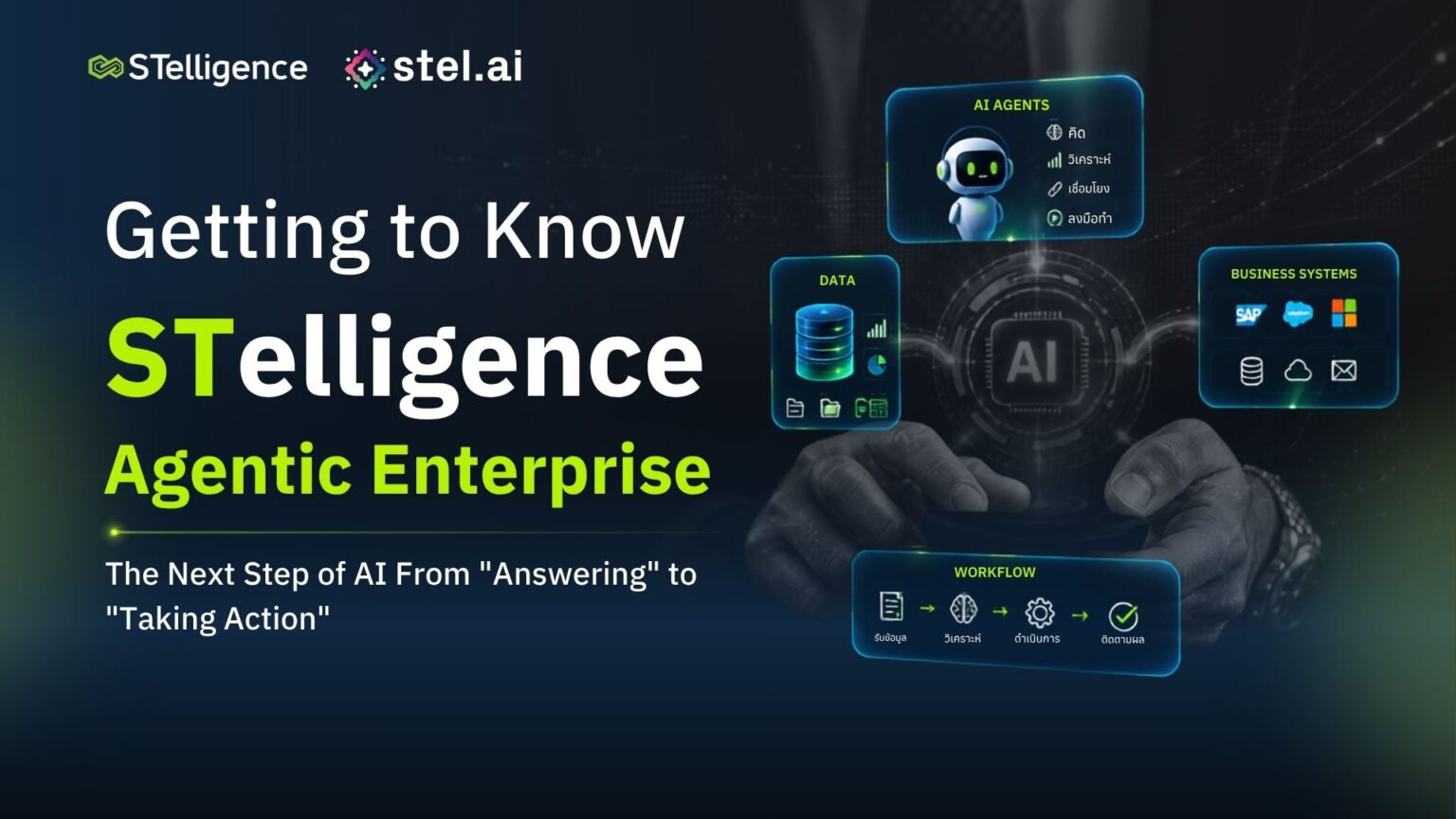
Getting to Know STelligence Agentic Enterprise: The Next Step of AI From "Answering" to "Taking Action"
As AI technology continues to transform how organizations operate, we are moving past the era where AI merely answers questions, summarizes information, or helps generate content. Today, AI is taking the next big step toward Agentic AI artificial intelligence capable of understanding goals, planning execution, and actively carrying out real business workflows.
STelligence Agentic Enterprise was developed to empower organizations to move beyond traditional AI adoption. It enables the creation of enterprise AI Agents that work systematically alongside people, data, and organizational systems handling everything from data access, analysis, and decision-making to executing pre-defined operational processes.
Imagine if AI didn’t just tell you what needs to be done but could take action for you immediately. Whether searching for and summarizing insights from documents, coordinating across multiple systems, or automating repetitive tasks, this capability does more than just save time it gives employees the freedom to focus on higher-value work requiring strategic thinking and complex decision-making.
This article will walk you through what STelligence Agentic Enterprise is, how it works, and how Agentic AI is set to redefine the future of workplace operations.
What is Agentic AI? From Question-Answering to Action-Taking
Over recent years, AI has increasingly served as a workplace assistant for answering queries, summarizing data, analyzing documents, and generating content based on user prompts. However, Agentic AI is driving a major evolution, taking AI from a passive assistant that “answers” to an active agent that can understand goals, plan, decide, and execute tasks independently.
The defining characteristic of Agentic AI is its goal-driven operation. When given an objective, the system can break down what needs to be done, map out sequential steps, and leverage relevant tools or data sources to achieve that goal without requiring step-by-step human prompts.
For example, instead of a user having to instruct AI step-by-step (“Summarize the sales report”), Agentic AI takes it further by retrieving relevant data, performing the analysis, drafting the summary, and generating a report based on defined workflows. This shifts AI from providing mere answers to directly participating in actual operational workflows.
With this framework, organizations can apply AI Agents across various domains—such as customer service, sales, marketing, finance, and data management by connecting them to existing data, core systems, and business workflows.
This marks the fundamental difference between the AI we knew and Agentic AI: From an AI waiting for commands to an AI that grasps goals and acts. It represents a crucial step for modern enterprises adopting AI that doesn’t just “talk well,” but “gets real work done.”
What is STelligence Agentic Enterprise & How Does It Help Organizations?
STelligence Agentic Enterprise is an enterprise-grade AI Agent builder designed to help organizations build and deploy AI Agents into real business operations ranging from easily accessible standard tasks to highly customized, complex domain-specific processes.
Seamlessly Integrating AI into Business Workflows
A core advantage is the ability to embed AI Agents directly into business workflows. These agents can receive data, analyze and process information, execute defined steps, and seamlessly connect with an organization’s existing software stack and applications. This approach allows organizations to reduce manual labor and multi-step repetitive tasks, while accelerating operational speed and boosting overall team productivity.
For organizations looking to deploy AI across business functions, B2B AI Agents can be custom-tailored to fit specific operational requirements whether in Sales, Marketing, Customer Service, Finance, Operations, or internal Knowledge Management. Operating as digital assistants, AI Agents work alongside employees and enterprise systems to handle end-to-end tasks, from initial data ingestion and analysis to final process execution.
Can AI Agents Really Do the Work for Us?
The short answer is “Yes” though that does not mean AI will replace humans entirely. The capability of an AI Agent depends on its architectural design, assigned goals, available data sources, connected tools, and designated access permissions.
Once an AI Agent receives an objective from a user, it can build a plan, break tasks down into actionable steps, invoke relevant tools or databases, and execute the workflow without constant human intervention at every step.
For instance, in customer service, an AI Agent can handle incoming inquiries, look up details in internal databases, analyze the issue, identify the fix, and respond to the customer directly. If a case is overly complex or exceeds defined boundaries, the system can seamlessly escalate it to a human agent. In enterprise operations, AI Agents can interact with databases, enterprise software, and business tools to execute complex, multi-step tasks continuously.
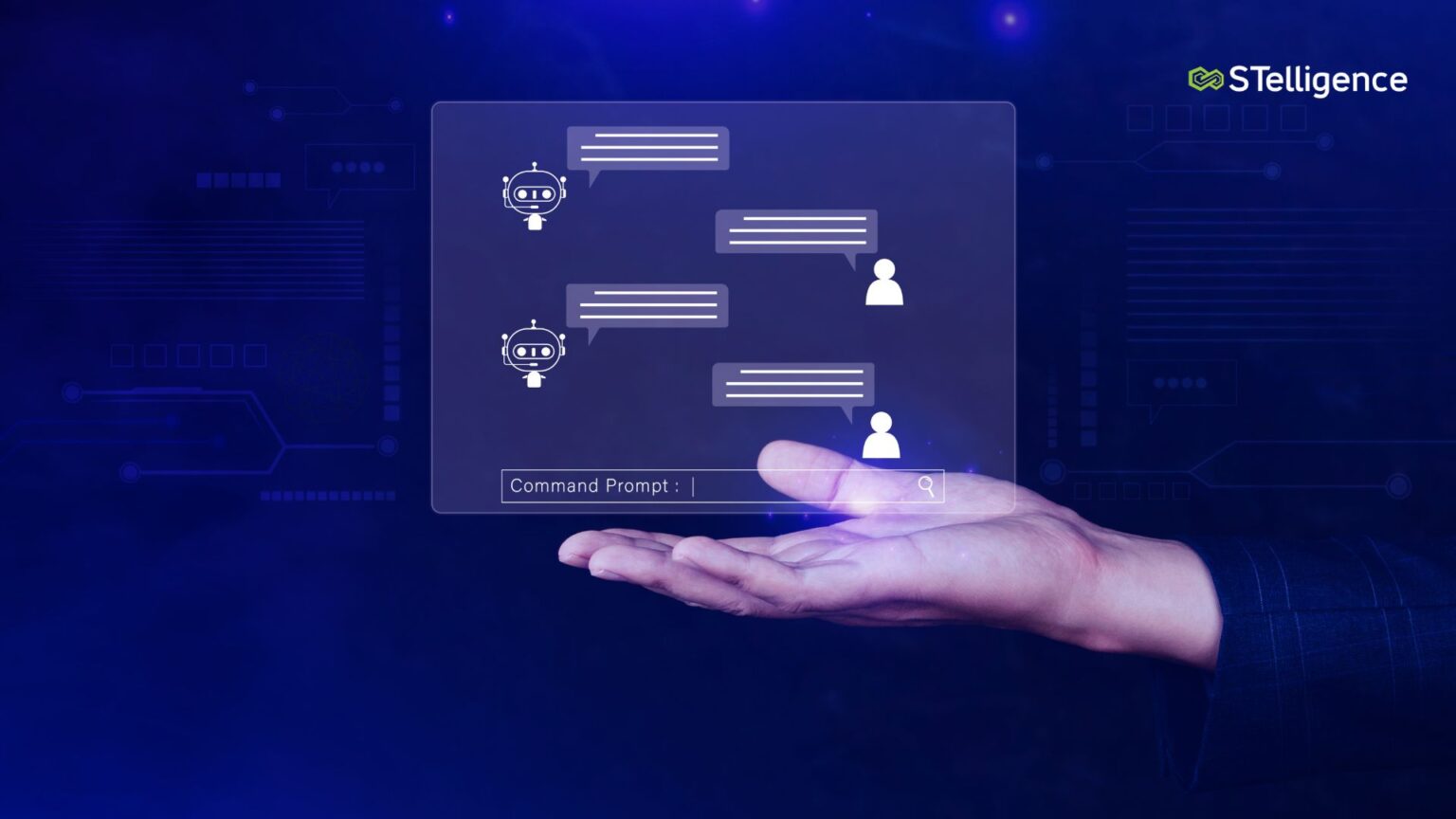
However, deploying AI Agents in real-world scenarios requires a Human-in-the-Loop approach, defined access privileges, output verification, and strict governance frameworks. This ensures that AI operations remain within organizational boundaries especially for tasks involving sensitive data or high-impact decisions.
Ultimately, the goal of an AI Agent is not to “replace human workers,” but to allow employees to “delegate suitable operational tasks to AI.” This reduces time spent on repetitive routines, freeing staff to concentrate on strategy, critical decision-making, and high-level expertise.
Practical Examples: Integrating AI Agents into Business Workflows
AI Agents can be applied across a wide variety of business workflows to assist with data ingestion, analysis, verification, and step-by-step execution. Common enterprise use cases include:
1. Accounting Workflows
AI Agents can process financial data by reading and validating invoices, extracting key information from documents, cross-checking data against pre-defined rules, and preparing summaries for accounting entries drastically cutting down manual work and document management time.
2. Document Management Workflows
AI Agents can read, analyze, and extract insights from documents such as PDFs, quotations, contracts, or business reports. They can automatically locate specific information and categorize documents, enabling faster data access and reducing operational friction.
3. Banking & Financial Services
AI Agents can handle processes tied to customer data and transaction management—such as validating information, analyzing applications, providing product details, or managing multi-step approval workflows. They connect to relevant core systems and escalate to human staff when necessary.
4. Customer Service Workflows
AI Agents act as intelligent customer service assistants by handling incoming queries, querying knowledge bases, troubleshooting issues, and delivering rapid responses. For complex issues, they pass cases to human agents alongside relevant context, lightening team workloads, and elevating customer experience.
5. Sales & Marketing Workflows
AI Agents can aggregate customer insights, qualify leads, generate pre-meeting briefing summaries, and automate follow-up cadences. This streamlines sales and marketing operations, ensuring structured, efficient pipeline management.
The Next Step for Enterprises: Moving from “Using AI” to “Working Alongside AI”
Enterprise AI adoption is shifting from viewing AI as a simple productivity tool to actively collaborating with AI Agents capable of retrieving data, performing analysis, and executing workflows. Meanwhile, human workers maintain oversight by setting goals, validating results, and making strategic decisions.
According to the Microsoft Work Trend Index 2025, 82% of leaders expect to deploy AI Agents to expand employee capabilities within the next 12–18 months.
For organizations ready to take this step, STelligence offers end-to-end Enterprise AI Agent Advisory Services from use-case analysis, workflow design, and architecture planning to full-scale Enterprise AI Agent Development. Supporting both No-Code setups and custom software development, STelligence builds tailored B2B AI Agents aligned with your real operational needs.
The next evolutionary leap for organizations is no longer just about “using AI.” It is about “working alongside AI” to eliminate redundancy, drive efficiency, and achieve stronger business outcomes.
Ready to Elevate Your Organization with AI Agents?
Let STelligence guide your business through every stage from business use-case analysis and workflow design to full development and deployment. Transform AI from a passive assistant into active software that works in tandem with your data, systems, and enterprise workflows.
[Click Here] to consult with the STelligence expert team and start building AI Agents tailored to your business goals.
FAQ: Frequently Asked Questions
1. What is Agentic AI?
Agentic AI refers to artificial intelligence capable of understanding goals, analyzing data, planning, making decisions, and executing multi-step workflows independently, rather than just answering questions or generating text from prompts.
2. How does Agentic AI differ from traditional AI?
Traditional AI relies on static prompts and single commands provided by users. In contrast, Agentic AI takes a high-level goal, breaks it into sequential tasks, and executes them continuously across systems without needing step-by-step human intervention.
3. Are AI Agents safe for enterprise use?
Yes. They can be engineered with strict role-based access control (RBAC), verification checkpoints, and Human-in-the-Loop oversight to ensure operations align with organizational governance and compliance policies.
4. What business functions can leverage Agentic AI?
It can be applied across accounting, document management, banking, customer service, sales, marketing, finance, operations, and any business function involving large volumes of data, repetitive tasks, or complex workflows.
5. How does implementing Agentic AI benefit an organization?
It minimizes manual and repetitive tasks, shortens task completion times, and empowers staff to focus on high-impact work requiring human analysis, expertise, and decision-making.
6. What is STelligence Agentic Enterprise?
STelligence Agentic Enterprise is a specialized enterprise AI Agent builder that allows organizations to create and deploy custom AI Agents that integrate directly with enterprise data, software systems, and business processes.
7. How does STelligence Agentic Enterprise integrate into existing workflows?
AI Agents ingest inputs, analyze data, and run step-by-step executions across existing business applications and software stacks using API integrations and workflow automation.
8. What development approaches does STelligence support?
STelligence supports everything from accessible No-Code AI Agent creation for rapid deployment to custom software development and advanced coding for highly complex, specialized business use cases.
9. What size organization is best suited for AI Agents?
AI Agents suit organizations of all sizes—particularly enterprises with high-volume repetitive tasks, document-heavy operations, or multi-step operational workflows.
10. How should an enterprise start adopting AI Agents?
Start by analyzing key operational pain points and identifying high-value use cases. Define your scope and targets, then design the AI Agent workflow accordingly. STelligence provides end-to-end support—from strategic consultation to full development and deployment.