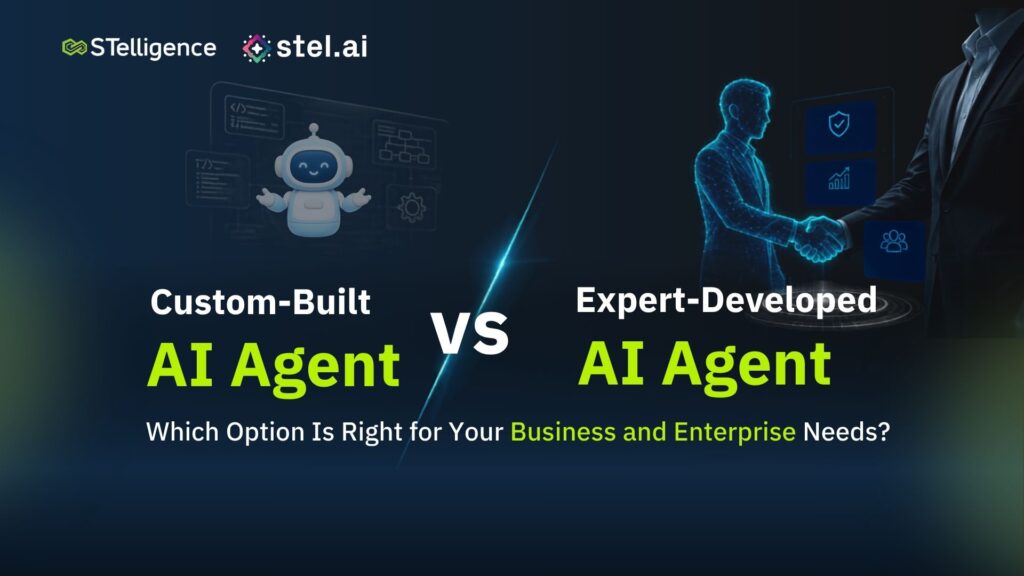
Build an AI Agent vs. Hire an Expert: Which Approach Is Right for Your Business?
AI Agents are playing an increasingly important role in organizations. They can analyze information, plan tasks, access data and tools, and execute workflows automatically.
Organizations can choose to build AI Agents in-house using Low-Code or Code-first approaches, or hire experts to develop more sophisticated Enterprise AI Agents. So, which approach is right for your business? This article compares the benefits, limitations, and key factors to consider before making a decision.
1. What Is an AI Agent and How Can It Help Your Business?
An AI Agent is a system that can receive a goal, analyze and plan tasks, access tools or data, and execute workflows. Common applications include Customer Service, Sales, Document Management, and Workflow Automation.
For example, a Customer Service AI Agent can receive customer inquiries, search a Knowledge Base, and generate a Draft Response for an employee to review before sending.
2. Building an AI Agent In-House: Benefits and Limitations
Building an AI Agent for your business is suitable for organizations with IT or development teams that want greater control over the development process. Organizations can start with Low-Code tools and use the Agent Development Kit (ADK) when more detailed control over Logic, Tools, and Workflows is required.
Benefits
- Full control over development and workflows
- Rapid prototyping and experimentation
- Builds internal AI knowledge and expertise
- Builds internal AI knowledge and expertise
Limitations
- Requires AI and technical expertise
- Requires the internal team to manage Integration, Security, and maintenance
- Complex projects may require more time and resources
3. What Can You Gain by Hiring an AI Agent Expert?
Hiring experts can be a suitable option for organizations without specialized teams or those looking to develop Enterprise AI Agents that integrate with multiple systems.
Experts can support the entire process, from Use Case → Workflow → Development → Integration → Deploy → Monitor, while also helping establish Security and Governance practices.

4. Build an AI Agent vs. Hire an Expert
In summary: If your organization has a technical team and is starting with a small Use Case, building an AI Agent in-house may be the right choice. However, if the project involves multiple system integrations, complex workflows, or strict Security and Governance requirements, working with an expert can help reduce complexity and the workload on internal teams.
5. Choosing the Right Approach for Your Organization
Before making a decision, consider these four key factors:
1. Business Use Case: What problem will the AI Agent solve, and what business outcomes can it deliver?
2. Workflow Complexity: Simple tasks may be suitable for Low-Code, while complex workflows may require Custom Code.
3. Data & Integration: Which data sources and business systems need to be connected?
4. Security & Governance: How should access permissions and AI Agent activities be controlled?
6. How Can STelligence Help Build AI Agents?
STelligence helps organizations develop Enterprise AI Agents, from Use Case analysis through to Production, using a comprehensive approach:

Consult → Design → Develop → Integrate → Deploy → Monitor
This includes Workflow design, AI Agent development, system and data integration, as well as Security, Governance, and Monitoring.
Conclusion
Choosing between building an AI Agent in-house vs. hiring an expert depends on your organization’s capabilities and the complexity of the project.
- Small Use Case + Technical Team: Consider building in-house
- Enterprise AI Agent + Multiple Systems + Complex Workflows: Consider working with an expert
The goal is not to build as many AI Agents as possible, but to create Agents that solve real business problems, deliver practical value, and work effectively with people, data, and enterprise systems.
FAQ: Frequently Asked Questions
Do you need a Developer to build an AI Agent in-house?
Not necessarily. Low-Code tools can make it easier to get started. However, complex workflows, multiple integrations, or advanced logic may require Developers or AI experts.
When should you hire an AI Agent expert?
Consider hiring an expert when the Agent needs to connect to multiple systems, handle sensitive data, manage complex workflows, or meet Security, Governance, and long-term maintenance requirements.
Which is more cost-effective: building in-house or hiring an expert?
It depends on the Use Case, available resources, project complexity, development time, and long-term maintenance costs. The initial development cost should not be the only consideration.
How long does it take to develop an AI Agent?
Development time depends on the complexity of the Workflow, the number of systems to be integrated, and Security and Integration requirements.
Can AI Agents connect to internal enterprise systems?
Yes. AI Agents can be designed to connect with enterprise Tools, systems, and data sources through supported Integrations or APIs, with appropriate access permissions and security controls.