How AI Is Changing the Business Landscape: How Can Organizations Prepare to Stay Competitive?
Over the past few years, AI has significantly changed the way organizations work. In the past, AI primarily served as a tool for searching for information, summarizing documents, or generating content. Today, AI is moving to the next level, with the ability to analyze information, plan tasks, use tools, and carry out processes continuously based on defined goals.
In particular, the concepts of AI Agents and Agentic AI are playing an increasingly important role in the enterprise. Google Cloud describes an Agentic Enterprise as an organization that integrates AI Agents into its operations, enabling them to work alongside people, data, and business systems to manage increasingly complex tasks and processes.
As a result, the key question for organizations today may no longer be simply, “Should we use AI?” but rather, “How can we apply AI to our business in a way that creates real value?”
Having AI within an organization does not automatically mean that the organization will work more efficiently. More importantly, organizations need to prepare their data, systems, people, and processes to work effectively with AI.
How Is AI Changing the Business Landscape?
Consider a typical business process. An employee may need to open an email to receive information, search for documents in Drive or an internal system, analyze the information, prepare a report, and then send it to the relevant stakeholders.
Traditional AI can help with individual steps, such as summarizing an email or analyzing a document. However, people still need to connect each step and move the process forward themselves.
The concept of Agentic AI is changing this approach by enabling AI to go beyond simply responding to requests and actively carry out tasks.
An AI Agent can receive a goal, determine the steps needed to achieve it, access relevant information or tools, and execute multiple tasks according to a predefined workflow. Google Cloud describes agentic workflows as workflows that can perform multiple steps, connect with different applications, and include human review or approval when required.
The key difference can be illustrated by comparing how traditional AI and AI Agents approach a task:
Traditional AI: The user asks a question, AI provides a response, and the human continues the work.
AI Agent: The user sets a goal, AI analyzes the requirements, plans the necessary steps, uses relevant tools, executes the workflow, and delivers the results.
In other words, AI is moving beyond being simply a “helper” that responds to individual requests and becoming an active part of an organization’s actual business processes.
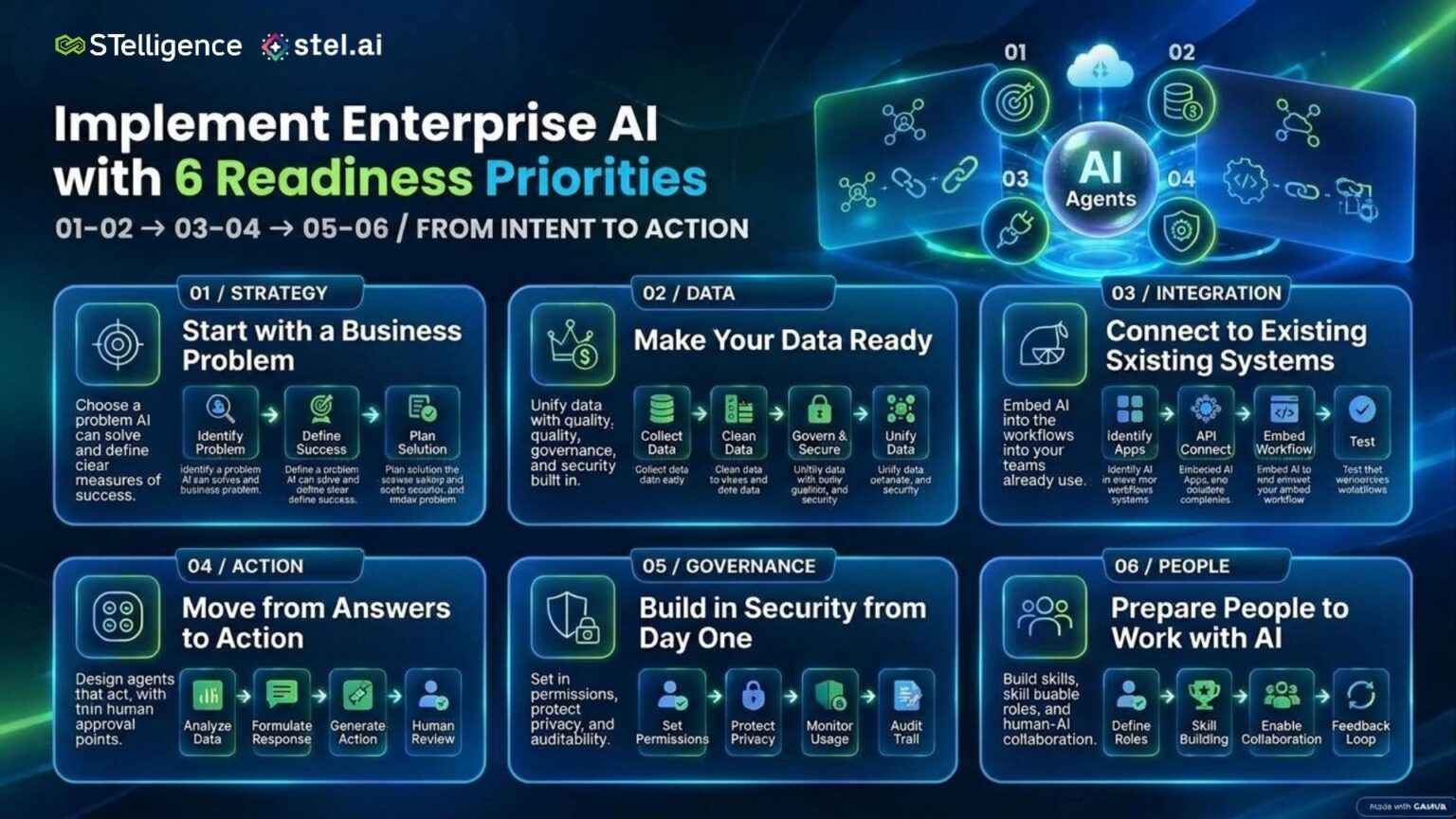
6 Key Areas Organizations Need to Prepare for in the AI Era
Successfully adopting AI is not simply about choosing the most powerful AI tool or model. Organizations need to consider everything from strategy and data to technology, processes, governance, and people.
1.Start with the Business Problem, Not the AI
Before choosing a technology, organizations should first ask: “What problem do we want AI to solve?” This could involve time-consuming tasks, repetitive work, searching for information across multiple systems, or processes that require many steps and handoffs.
Once the pain point has been identified, organizations can determine which type of AI solution is appropriate.
Adopting AI simply because “everyone is using it” does not necessarily mean it will create business value. Starting with a clear business use case also helps organizations define measurable outcomes, such as how much working time can be reduced, how many process steps can be eliminated, or how much faster a team can complete its work.
2. Prepare Your Data, Because Even the Most Powerful AI Needs Usable Data
Another major challenge for organizations is data. Business data is rarely stored in a single location. It may be distributed across CRM systems, ERP platforms, email, databases, documents, or department-specific applications.
Therefore, AI transformation is not simply about having large amounts of data. Organizations need to ensure that AI can access the right data, in the right context, with the appropriate access controls.
Google Cloud has highlighted fragmented data and systems as important challenges to achieving AI-driven transformation at the enterprise level.
Organizations should therefore consider several areas of data readiness, including:
- Data Quality
- Data Governance
- Data Integration
- Data Security
The ultimate goal is not simply to have more data, but to turn data into insights, insights into decisions, and decisions into action.
3. Connect AI with the Systems Your Organization Already Uses
AI can create greater value when it is connected to the systems an organization already relies on rather than operating as a standalone tool. Imagine an AI system that can access email, search documents, check information in a CRM system, and send the results into the appropriate workflow.
Instead of employees manually handling each step, from receiving a request and searching for data to analyzing, verifying, generating results, and forwarding them, AI can help orchestrate these activities as part of a connected workflow.
Google Cloud describes AI Agents as being capable of connecting with data and tools to perform multi-step tasks, including working with applications such as Gmail, Drive, Jira, ServiceNow, and other platforms.
Therefore, Enterprise AI should not be viewed simply as another chatbot. It should be viewed as part of the business workflow.
4. Move from AI That Answers to AI That Takes Action
This is where AI Agents can play a significant role. Consider a Compliance process in which a team needs to receive a request, search relevant policies, check requirements, analyze the information, and prepare a summary.
An AI Agent can assist with different stages of this workflow from retrieving information and analyzing it to preparing an output for review by the responsible employee.
Importantly, AI Agents do not necessarily mean “letting AI do everything on its own.”
Instead, organizations need to define:
- Which tasks AI can perform
- Which tasks require human review
- Which actions require approval
- What information AI can access
- What tools AI can use
Google Cloud’s workflow capabilities support both AI Automation and Human Approval within workflows, allowing organizations to combine automation with human oversight.
The goal is not to remove people from the process, but to design a workflow in which AI and people each handle the tasks they are best suited for.
5. Build Security and Governance from the Beginning
As AI gains access to organizational data and business systems, security and governance become increasingly important.
Organizations need to clearly define:
- What data can AI access?
- Who can use AI?
- What actions can AI perform?
- Which steps require human approval?
- Can AI activities be monitored and audited?
To help organizations manage these risks, the NIST AI Risk Management Framework (AI RMF) provides guidance for incorporating trustworthiness and risk management into the design, development, use, and evaluation of AI systems.
In practice, this means that before asking, “What can AI do?” organizations should also ask: “What should AI be allowed to do, and under what conditions?”
6. Prepare People to Work Alongside AI
Finally, even with the right technology in place, transformation can be difficult if employees do not know how to apply AI effectively to their work.
Employees need to understand how to use AI appropriately, recognize its limitations, verify its outputs, and identify where AI can add value to their workflows. The future of work may therefore be less about Human vs. AI and more about Human + AI.
People can continue to define objectives, make decisions, and provide oversight, while AI assists with tasks and processes that are suitable for automation.
Where Should Organizations Start?
Organizations do not need to transform everything at once.
A practical approach is to start with a clearly defined use case, test it within a limited scope, measure the results, and then expand gradually.
1. Identify — Find the Pain Point Identify processes that are time-consuming, repetitive, complex, or dependent on information from multiple systems.
2. Prioritize — Select the Right Use Case Evaluate which use cases have clear business value and are suitable for AI implementation.
3. Pilot — Run a Pilot Start with a limited implementation to test the technology, workflow, and user experience.
4. Measure — Measure the Results Evaluate the pilot against predefined KPIs, such as time saved, process efficiency, accuracy, or productivity.
5. Scale — Expand to Other Teams and Workflows Once the organization understands what works, the solution can be expanded to additional teams, processes, and business functions.
This approach allows organizations to see tangible results while learning and improving before deploying AI at a broader scale.
STelligence Agentic Enterprise and the Journey Toward an AI-Ready Organization
When organizations want to integrate AI into their business processes, one of the key challenges is connecting AI + Data + Business Systems + Workflow.
STelligence Agentic Enterprise provides an approach for organizations looking to adopt Enterprise AI Agents that can work with organizational data, systems, and business processes.
The core concept is to enable AI to understand information, analyze it, make decisions, and take action within workflows and boundaries defined by the organization. This approach can be applied across functions such as Finance, Compliance, Legal, HR, Sales, and Back Office.
The goal of Enterprise AI is not simply to make AI “better at answering questions.” It is about integrating AI into real business processes and turning Intelligence into Action.
Conclusion
AI is changing the way organizations work. Preparing for this transformation should go beyond simply selecting an AI tool.
Organizations need to consider the full picture, connecting strategy, data, technology, AI Agents and workflows, governance, and people. Ultimately, the value AI creates for a business does not depend on technology alone. It depends on how effectively an organization can integrate AI with its people, data, systems, and processes.
The key question may therefore no longer be: “Is your organization using AI yet?” Instead, organizations should ask: “How much more can AI help your organization accomplish today?”
If your organization is exploring how to apply AI Agents to your business—whether for data analysis, workflow automation, or connecting AI with existing systems and business processes the STelligence team can provide consultation and help design an AI Agent approach tailored to your organization’s specific context and requirements.
References
- Google Cloud — Building the agentic enterprise — Provides an overview of the Agentic Enterprise concept and how AI Agents can work alongside people and business processes.
- Google Cloud — What are agentic workflows? — Explains agentic workflows, including planning, tool usage, and multi-step task execution.
- Google Cloud — Workflows overview — Provides information about workflows, AI automation, and human approval capabilities.
- NIST — AI Risk Management Framework: Generative AI Profile — Provides guidance on AI risk management and risks associated with generative AI.
- Google Cloud — Gemini Enterprise Agent Platform — Provides information on building, scaling, governing, and deploying enterprise AI agents.
FAQ Frequently Asked Questions
Where should an organization start when adopting AI?
Organizations should begin by identifying a clear business problem or pain point and then select the appropriate technology. Examples include repetitive tasks, time-consuming processes, searching for information across multiple systems, or workflows involving multiple steps.
From there, organizations can start with a small use case, run a pilot, and measure the results before expanding AI adoption across other areas of the organization.
How can AI Agents create value for businesses?
AI Agents can help reduce repetitive work, shorten processing times, and connect information from multiple systems with business workflows.
This can allow employees to spend more time on tasks that require human judgment, decision-making, and creativity.
Why is Data Readiness important for AI adoption?
AI needs access to high-quality and relevant data to produce useful results.
If data is fragmented, inaccessible, outdated, or governed by inappropriate access controls, AI may not be able to deliver its full potential.
Organizations should therefore prepare across multiple areas, including Data Quality, Data Integration, Data Governance, and Data Security.
How can organizations use AI Agents safely and maintain control?
Organizations should define clear boundaries for AI Agents, including data access, available tools, permitted actions, and steps that require Human Approval. Regular monitoring and auditing can also help ensure that AI operates securely and within the organization’s governance policies.
What should organizations prepare for to become AI-Ready?
Organizations should prepare systematically across at least six key areas:
AI Strategy, Data, Technology & Infrastructure, AI Agent & Workflow, Governance & Security, and People & AI Skills.
Creating business value from AI does not depend on technology alone. It requires effective collaboration between:
AI + Data + People + Process + Technology