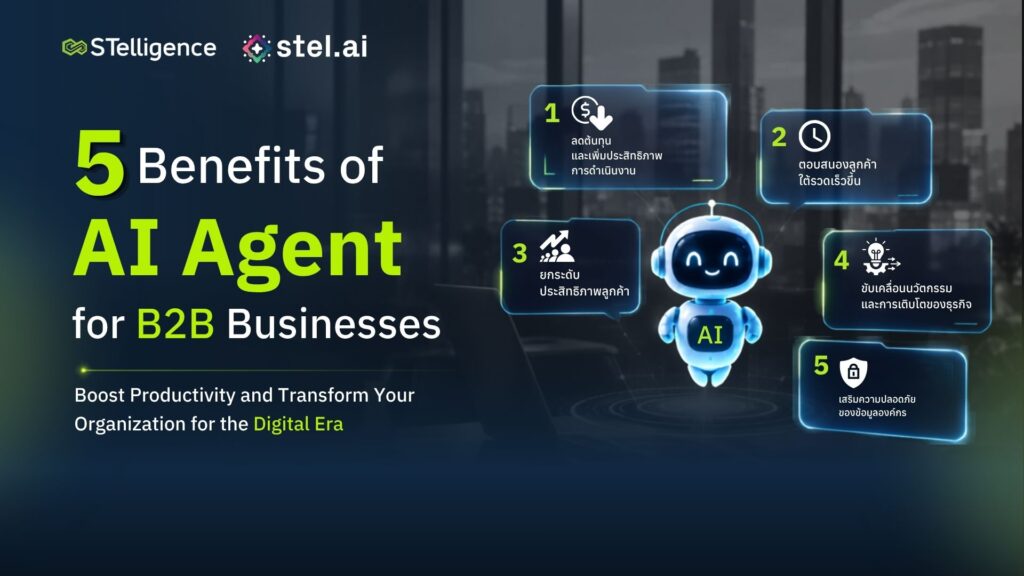
5 Benefits of AI Agents for B2B Businesses: Elevating Your Enterprise
In an era where organizations must manage vast amounts of data and navigate complex workflows, B2B AI Agents are stepping in to help enterprises operate with greater speed, agility, and efficiency.
Unlike conventional AI that focuses solely on prompt-response interactions, AI Agents do far more than just reply to questions. They can plan, analyze data, invoke tools, and execute defined workflows end-to-end, with human oversight kept at crucial decision points.
This article explores 5 key benefits of AI Agents for B2B businesses, complete with real-world application examples that enhance operational performance and support enterprise growth.
What is a B2B AI Agent?
A B2B AI Agent is an artificial intelligence system that takes high-level goals or user commands and autonomously utilizes relevant data sources, tools, and systems to execute tasks step-by-step.
Its defining strength is multi-step execution handling everything from receiving instructions, analyzing context, and querying cross-platform databases to performing operational tasks or escalating cases for human review.
The concept of Human-Agent Teams is gaining rapid adoption. Microsoft highlights that the future of work centers on collaboration between human workers and AI Agents, expanding team capability and operational scale.
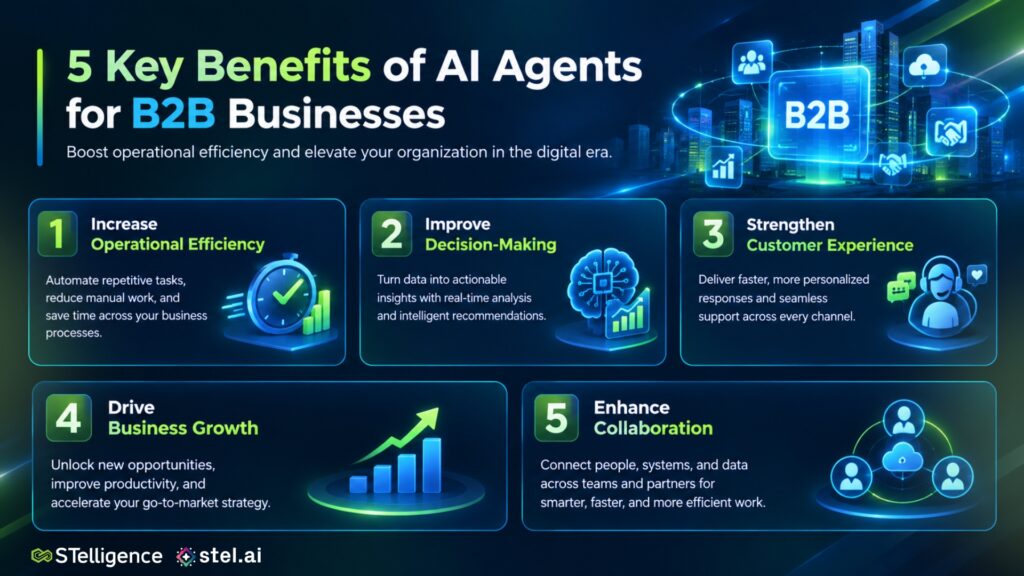
5 Benefits of AI Agents for B2B Businesses
1. Reduce Redundant Tasks and Drive Efficiency
AI Agents automate routine execution such as data lookup, document summarization, email triage, and rule-based validation. This drastically cuts the time employees spend on repetitive tasks, allowing teams to redirect focus toward high-value, strategic initiatives (2026 Work Trend Index Annual Report).
2. Connect Data and Internal Systems
B2B enterprises often operate with fragmented data spread across CRMs, ERPs, email systems, and document repositories. AI Agents bridge these disconnected databases, platforms, and workflows, eliminating manual data re-entry and reducing context-switching between multiple software applications (Microsoft Learn).
3. Advance Data Analytics and Support Decision-Making
AI Agents synthesize information across disparate channels customer records, sales metrics, internal reports, and policy documents giving teams rapid access to critical insights (2026 Work Trend Index Annual Report).
For high-stakes or sensitive decisions, workflows incorporate human approval checkpoints to ensure accuracy, alignment, and contextual appropriateness for the business.
4. Elevate Customer Service Excellence
AI Agents handle customer inquiries around the clock by searching knowledge bases, checking order statuses, and categorizing tickets. When encountering edge cases or complex requests, they seamlessly transfer context to human representatives.
Microsoft notes that Customer Service is a primary function where enterprises are deploying AI Agents to boost operational efficiency and elevate overall customer experience (Microsoft – The Future of AI: Harnessing AI Agents for Customer Engagements).
5. Scale Business Growth Seamlessly
As a business grows, data volumes, client accounts, and operational tasks increase exponentially. AI Agents manage structured, repetitive tasks at scale, enabling enterprises to handle larger workloads without adding proportional staffing burden at every step (2026 Work Trend Index Annual Report).
How AI Agents Fit B2B Business Functions
AI Agents can be deployed across core enterprise departments:
Sales: Research prospect profiles → Summarize account history → Prepare pre-meeting briefings.
Marketing: Analyze campaign metrics → Automate content workflows → Compile performance reports.
Customer Service: Receive inquiries → Query knowledge base → Deliver instant answers → Escalate to human agents as needed.
Finance: Parse invoices → Validate line items → Summarize statements → Route to finance leads for approval.
HR: Query policy handbooks → Answer employee FAQs → Escalate specialized cases to HR specialists.
Operations: Track task statuses → Coordinate cross-system updates → Keep operational workflows current.
Implementing AI Agents should begin with the business problem and workflow pain points rather than starting with the underlying technology alone.
Furthermore, AI Agents should act as intelligent assistants that prepare and analyze data, leaving final sign-off and critical decisions to human experts especially for high-risk operations.
Step Into AI Workflow Automation with STelligence
As AI Agents redefine modern business operations, B2B enterprises should start by selecting high-impact workflows and designing an optimal collaborative framework between humans and AI.
The STelligence Agentic Enterprise App Platform is more than just an agent-building tool; it is an end-to-end solution that guides organizations to become AI-Augmented Organizations systematically. Our services span AI readiness assessment, enterprise architecture design, cost-effective model selection, and co-developing AI Agents integrated with your corporate data, core platforms, and business logic.
STelligence’s team of experts provides strategic guidance to align AI adoption with your core business targets, transitioning your organization from experimental AI pilots to measurable, tangible business outcomes.
Ready to Deploy AI Agents in Your Organization?
Consult with the STelligence expert team today to assess your AI Readiness and identify the most impactful AI Agent use cases for your business.
FAQ: Frequently Asked Questions
What is a B2B AI Agent?
A B2B AI Agent is an artificial intelligence system that receives instructions, analyzes contextual data, formulates action plans, invokes external software tools, and carries out multi-step workflows to increase enterprise efficiency.
How does an AI Agent differ from a standard AI Chatbot?
AI Chatbots focus primarily on answering queries or generating text. In contrast, AI Agents execute continuous action steps based on commands such as querying databases, verifying documents, triggering APIs, coordinating across systems, and running multi-step processes with human checkpoints.
How do AI Agents help B2B businesses?
AI Agents reduce redundant operational tasks, integrate fragmented corporate systems, support analytical decision-making, elevate customer service response times, and allow business operations to scale without a proportional increase in workload burden.
Which departments can leverage AI Agents?
AI Agents can be deployed across Sales, Marketing, Customer Service, Finance, HR, Operations, and Procurement, targeting workflows with defined operational steps.
Can AI Agents completely replace human employees?
No. AI Agents excel at managing repetitive, rule-based workflow execution, while human workers maintain strategic oversight, audit results, and handle high-risk or high-impact decision-making.
How should an enterprise begin adopting AI Agents?
Start with an AI Readiness Assessment to identify process bottlenecks and high-friction workflows. Next, design AI Agents tailored to your enterprise data access, system integrations, security policies, and business goals, incorporating robust governance and oversight frameworks.