How Safe Are Enterprise AI Agents?
What Businesses Need to Know Before Deployment
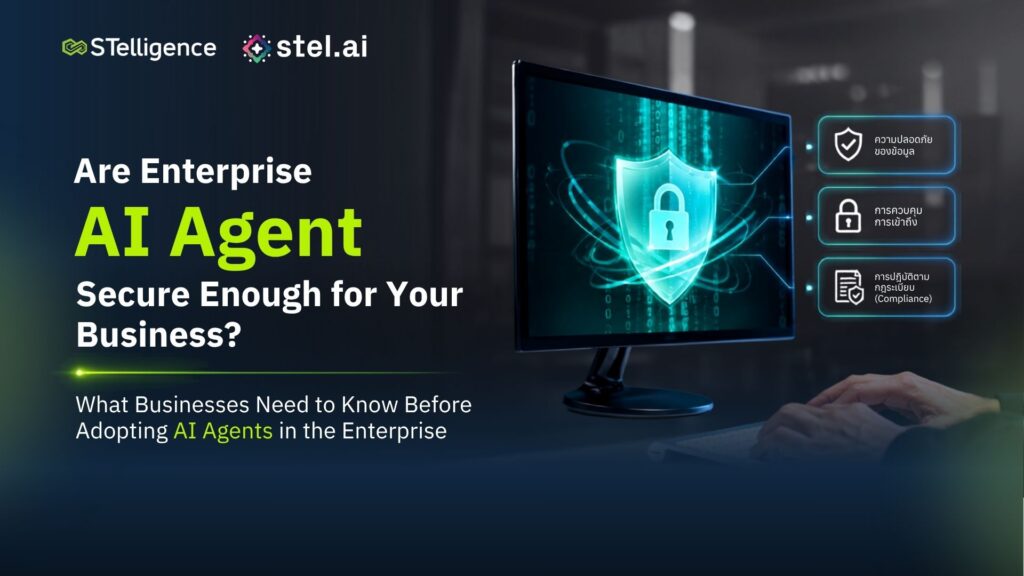
AI Agents are playing an increasingly vital role in helping organizations automate workflows from searching and analyzing data to managing documents and connecting disparate business systems. However, when AI Agents interact with critical corporate data, an unavoidable question arises: “How safe are Enterprise AI Agents?”
In an enterprise context, security extends far beyond basic data leak prevention. It encompasses identity access management, execution boundaries, activity auditing, data privacy, and governance alignment with corporate policy.
This article explores the security risks associated with Enterprise AI Agents, the security measures organizations must evaluate, and how to prepare your infrastructure to deploy AI Agents safely and confidently.
How Safe Are Enterprise AI Agents? Why Security Matters
An Enterprise AI Agent differs fundamentally from a consumer-facing Q&A chatbot because it connects directly to internal databases, applications, software tools, and line-of-business systems to execute workflows.
For example, an AI Agent may be granted permission to search internal documents, verify data, compile reports, or write records to external software. Without proper permission scopes and operational boundaries, this connectivity can introduce significant risk to an enterprise’s data and software ecosystem.
Evaluating AI Agent security requires looking beyond the core AI model to encompass Data Security, Identity & Access Control, Privacy, Monitoring, and Governance.
The core principle is simple: AI Agents must only access data necessary for their specific tasks and operate strictly within boundaries set by the organization.
5 Security Risks of AI Agents Every Organization Must Know
Before deploying B2B AI Agents, businesses must understand potential vulnerabilities to implement appropriate safeguards:
1. Sensitive Data Exposure: AI Agents process confidential business information, including internal documentation, customer PII, financial records, and HR data. Improper data handling risks unauthorized access or accidental exposure.
2. Excessive Access Privileges: If an AI Agent is granted broader data access than required, users interacting with it might retrieve information above their security clearance. Role-Based Access Control (RBAC) is essential to prevent privilege escalation.
3. Out-of-Bounds Execution: Because AI Agents can perform multi-step actions autonomously, organizations must clearly define which actions agents may complete independently and which require mandatory human sign-off.
4. Prompt Injection & AI Threats: Emerging threats, such as Indirect Prompt Injection, attempt to manipulate an agent’s reasoning, bypass system instructions, or exfiltrate restricted data. Robust input/output guardrails are required when agents interact with external data streams.
5. Operational Errors & Hallucinations: AI Agents may misinterpret data or execute unintended workflow steps. Building verification steps and human validation gates into critical processes mitigates operational risk.
Essential Security Features for Enterprise AI Agents
Evaluating an Enterprise AI Agent platform should focus not only on functional capabilities but also on enterprise-grade security and control mechanisms:
- Role-Based Access Control (RBAC): Restricts data access based on user roles (e.g., Executives, Accounting, HR, or IT), ensuring individuals and agents only interact with role-appropriate information.
- Authentication & Authorization: Enforces identity verification checks before granting access to internal data or allowing system modifications, preventing unauthorized execution.
- Data Encryption: Protects data in transit and at rest using robust encryption protocols to safeguard sensitive assets against interception.
- Monitoring & Audit Trails: Provides comprehensive logging of agent actions, data queries, and execution timestamps to enable anomaly detection and forensic auditing.
- Granular Scope Definition: Restricts individual agents to specific system permissions rather than granting broad network access, maintaining a principle of least privilege.
Human-in-the-Loop & AI Governance: Keeping Agents Secure
While AI Agents can execute tasks autonomously, high-risk operational steps should not be left entirely unmonitored.
The Human-in-the-Loop (HITL) framework inserts human oversight at critical checkpoints—such as financial transactions, sensitive data updates, external communications, or high-impact business decisions.
Example: An AI Agent can validate invoice data, verify vendor records, and prepare an approval draft. However, final payment execution requires explicit authorization from a human finance manager.
Alongside Human-in-the-Loop controls, a comprehensive AI Governance framework defines operational parameters:
- Who holds authorization to build and deploy AI Agents.
- Which data repositories specific agents can access.
- Which processes can run fully automatically vs. those requiring human sign-off.
- How agent execution logs are maintained and audited.
- Protocols for incident response and exception handling.
A clear governance framework allows enterprises to scale AI Agent adoption systematically without exposing the business to unnecessary risk.
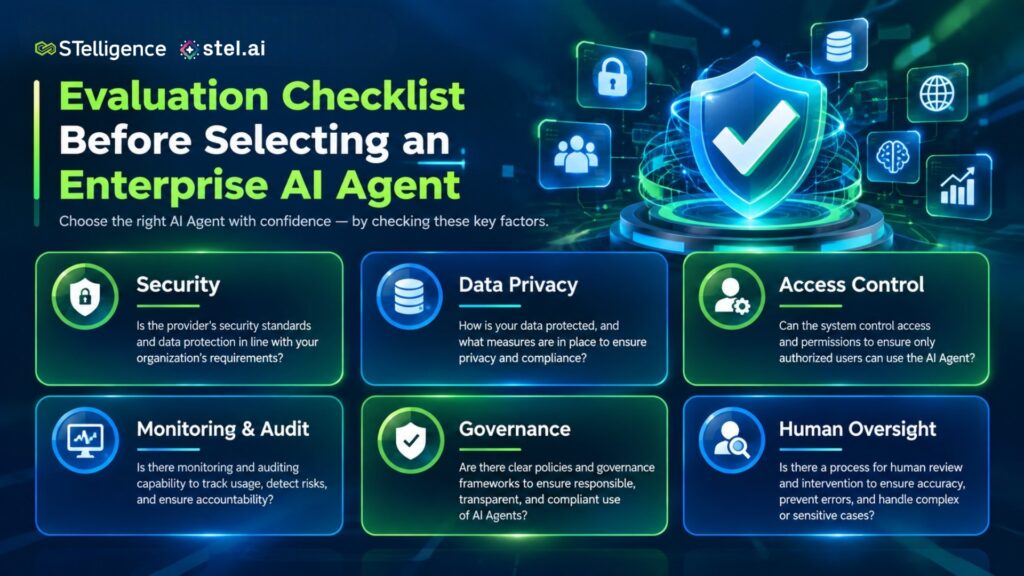
Evaluation Checklist Before Selecting an Enterprise AI Agent
Before deploying an Enterprise AI Agent solution, evaluate both platform capabilities and security controls using this baseline checklist:
✔ Security: Does the platform feature end-to-end data protection and threat prevention mechanisms?
✔ Data Privacy: How is corporate and customer data processed, and are strict boundaries enforced to prevent unauthorized model training?
✔ Access Control: Can user and agent access privileges be restricted at a granular level?
✔ Monitoring & Audit: Does the system maintain detailed execution logs and audit trails for all agent activities?
✔ Governance Policy: Can enterprise governance rules, operational boundaries, and compliance policies be embedded directly into agent workflows?
✔ Human Oversight: Does the platform support configurable Human-in-the-Loop approval gates for high-risk actions?
Deploying Enterprise AI Agents Safely
Enterprise AI Agents offer significant productivity gains and workflow automation capabilities. However, increased operational autonomy must be matched by robust security controls.
Organizations should look beyond what an AI Agent can do and evaluate how securely it operates and how precisely it can be controlled.
Combining Security, Access Control, Data Privacy, Continuous Monitoring, Human-in-the-Loop gates, and AI Governance allows enterprises to deploy AI Agents across core workflows safely while building a foundation for future AI expansion.
Ready to Deploy Secure AI Agents in Your Organization?
Elevate your enterprise operations with Enterprise AI Agents designed specifically around your data architecture, software stack, and business workflows.
Consult with the STelligence expert team to assess your AI Readiness, analyze enterprise requirements, and co-design a secure B2B AI Agent strategy built on security, data privacy, and robust AI governance.
FAQ: Frequently Asked Questions
Are Enterprise AI Agents secure?
Yes, when engineered with enterprise-grade security controls. These include Role-Based Access Control (RBAC), multi-factor authentication, end-to-end encryption, continuous monitoring, and detailed audit trails to maintain operational control.
Does an AI Agent need access to all corporate data?
No. AI Agents should follow the principle of least privilege. Organizations can restrict an agent’s access scope to only the specific data stores and APIs required to perform its assigned function.
Can an organization intervene if an AI Agent makes an error?
Yes. Enterprise systems can be designed with strict execution guardrails and Human-in-the-Loop checkpoints, requiring human validation before an agent completes high-risk or final-stage actions.
How do Enterprise AI Agents protect confidential business data?
They enforce role-based access policies, encrypt data in transit and at rest, isolate tenant environments, and maintain audit logs to prevent unauthorized data exposure and track system activity.
How should a business prepare before deploying AI Agents?
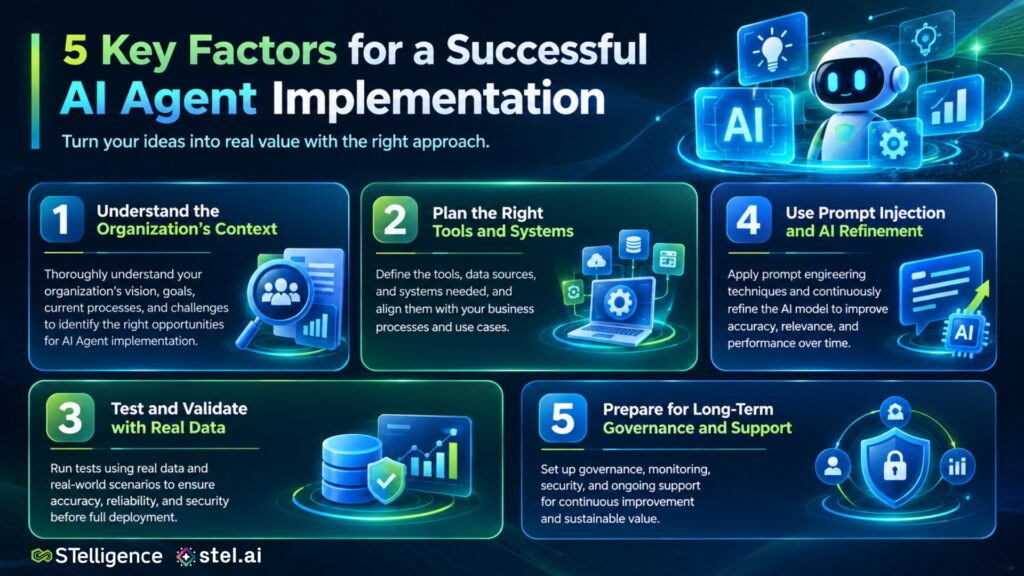
Start with an AI Readiness Assessment across data readiness, IT infrastructure, workflows, security standards, and workforce preparation. Select a clear, well-defined use case and establish security boundaries before expanding across the broader enterprise.
How does STelligence help organizations deploy secure AI Agents?
STelligence provides end-to-end advisory, architectural design, and custom development services. We analyze workflow requirements, evaluate AI Readiness, and build tailored Enterprise AI Agents that integrate with existing systems while strictly adhering to security, data privacy, and governance standards.